How Reliability Engineering and Quality Standards Create Long-Lasting Products
In today’s competitive landscape, delivering a high-performing product is no longer enough, and organizations must ensure that performance is sustained over time. This is where the integration of quality and reliability becomes critical.
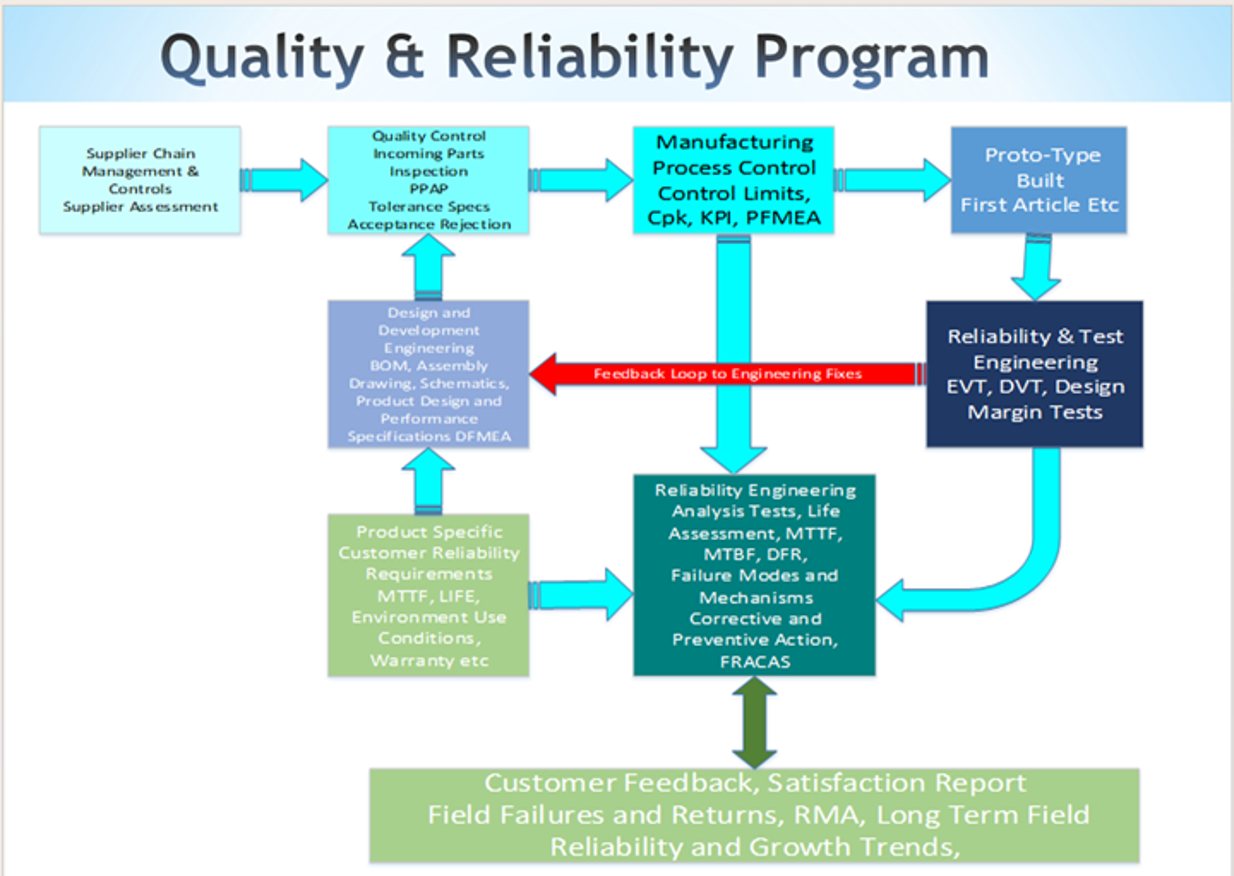
A robust reliability and quality program is not a single initiative, but a cross functional commitment. It must be embedded from the earliest stages of product development and supported by every function from design and engineering to supply chain and manufacturing throughout the New Product Introduction (NPI) lifecycle.
Quality reflects how a product performs at a given moment. Reliability, on the other hand, measures how that performance endures over time. While high quality is a prerequisite for strong reliability, the two are not interchangeable. A product may meet specifications today yet fail to perform consistently in the field if reliability has not been intentionally designed into it.
Reliability is influenced by multiple factors, including component quality, manufacturing processes, environmental conditions, and system level design decisions. It is ultimately measured by performance over the product’s lifecycle often expressed through metrics such as failure rates and operational lifespan while quality is assessed through adherence to specifications at defined checkpoints.
Embedding Reliability from the Start
High-performing organizations understand that reliability cannot be tested into a product, rather it must be designed into it.
This requires:
- Early integration of reliability practices within the design phase
- Alignment across product development and production teams
- Use of structured methodologies such as DFMEA and PFMEA
- Continuous improvement through frameworks like DMAIC
Equally important is a shift in mindset: knowing how to calculate reliability is valuable, but knowing how to build and sustain it is what differentiates leading organizations.
Critical Drivers of Reliability
From concept to production, several core elements shape a product’s long term performance:
- Supply chain robustness
- Effective quality control systems
- Consistent manufacturing process control
- Strong alignment between design, specifications, and real-world performance requirements
- Rigorous prototype builds and validation processes
Reliability assessments and testing should begin once these foundational elements are stable, ensuring that insights are both meaningful and actionable.
Sustaining Reliability in the Field
Reliability does not end at product launch rather it evolves with real world use.
A comprehensive Design for Reliability (DFR) approach includes:
- Life characterization testing
- Reliability modeling and predictions (MTBF, MTTF, MTTR)
- Failure analysis with corrective and preventive actions
- Continuous feedback loops from customers and field data
- Monitoring of returns and field failures (RMA)
- Ongoing reliability growth initiatives
Organizations that excel in reliability treat field performance as a critical input, not an afterthought.
Final Thought
Sustainable product success is built on more than meeting specifications. it requires designing systems that perform consistently, predictably, and reliably over time. Organizations that embed reliability into their culture, processes, and decision making will ultimately deliver greater value to their customers and maintain a stronger competitive advantage.